.svg)
.svg)


Executive Summary
The ADR vs EDR question matters for any organization evaluating application detection and response alongside traditional endpoint tooling. Traditional EDR and CWPP runtime sensors are valuable for infrastructure and workload security. They can observe process execution, network activity, file activity, system calls, and container/workload context. This is important, but it is not the same as application-runtime visibility.
ADR also sees process, network, syscall, container, image, pod, node, and workload context. The difference is that ADR ties these runtime events back to the exact application runtime, code, library, function, and call chain that caused the behavior.
This distinction matters most for CISOs responsible for software factories: organizations that build, ship, and operate code at high velocity. For those organizations, the adr security question is not only “what did the workload do?”; but “which part of our application or open-source dependency caused it, is it expected, and what should the developer fix?”
EDR / CWPP sees the process. ADR sees the application runtime and connects process/network/syscall activity to the specific library/function chain responsible for it.
The Core Difference: EDR Runtime View vs. ADR Runtime View
A traditional EDR/CWPP runtime sensor may correctly detect that a process created a child process, executed a command, opened a network connection, or performed a syscall. ADR detects these same categories of runtime behavior as well. The core difference is attribution and depth. Endpoint Detection and Response tools operate at the OS boundary; they cannot see inside the application runtime.
ADR connects the runtime event back to the exact library, function path, syscall, container, image, pod, service, and policy context. This provides a direct root cause for both security teams and developers.
Runtime Code Visibility Across 10+ Languages
The difference is not that ADR merely recognizes a process named python, java, node, or dotnet. A traditional runtime sensor can often see a runtime process at the OS level. ADR goes deeper: it maps runtime activity back to application libraries and functions across major language runtimes.
Supported runtimes include Java, Node.js, Python, Go, .NET, C/C++, Ruby, PHP, Kotlin, and Scala.
This language-aware runtime security visibility is what makes ADR useful for security leaders responsible for software development organizations. ADR connects infrastructure events to code ownership and developer remediation, not only to workload investigation. For more on what runtime security covers, see runtime security.
Why Granularity Matters: Legitimate Library Behavior vs. Exploit-Driven Behavior
Some runtime behaviors look suspicious from the outside but are legitimate when viewed with application context. For example, a Python library may run a feature check at the CPU level, such as checking SVE support, and trigger fork/exec behavior as part of legitimate runtime behavior. A regular EDR may alert on the process activity and create a long SOC investigation because it does not know which library and function path caused it.
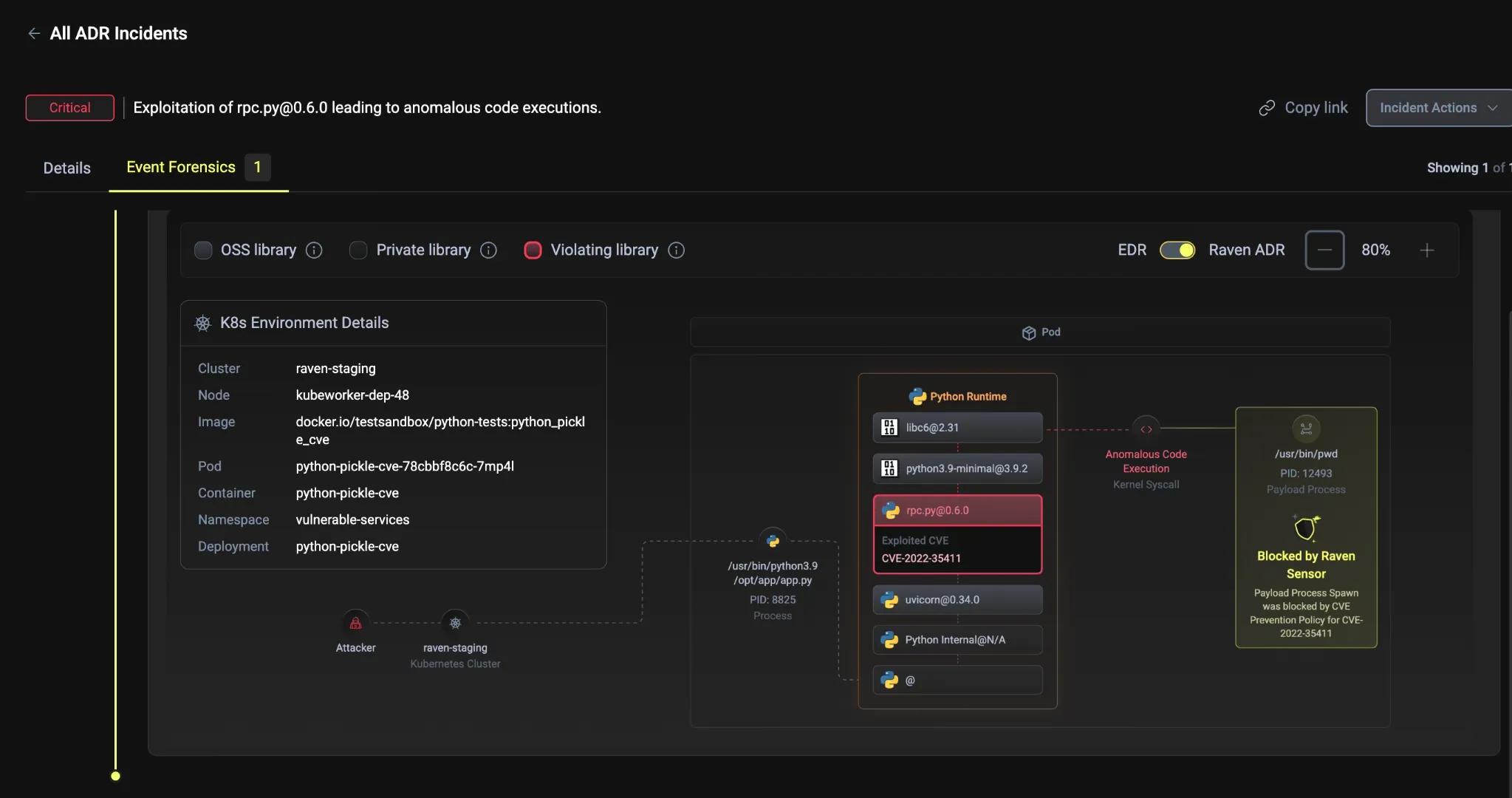
ADR can shorten that investigation by showing the runtime chain that caused the action. Instead of asking analysts to manually reverse-engineer the process tree, ADR can show the relevant library/function chain and whether the behavior matches expected library behavior or exploit-driven misuse.
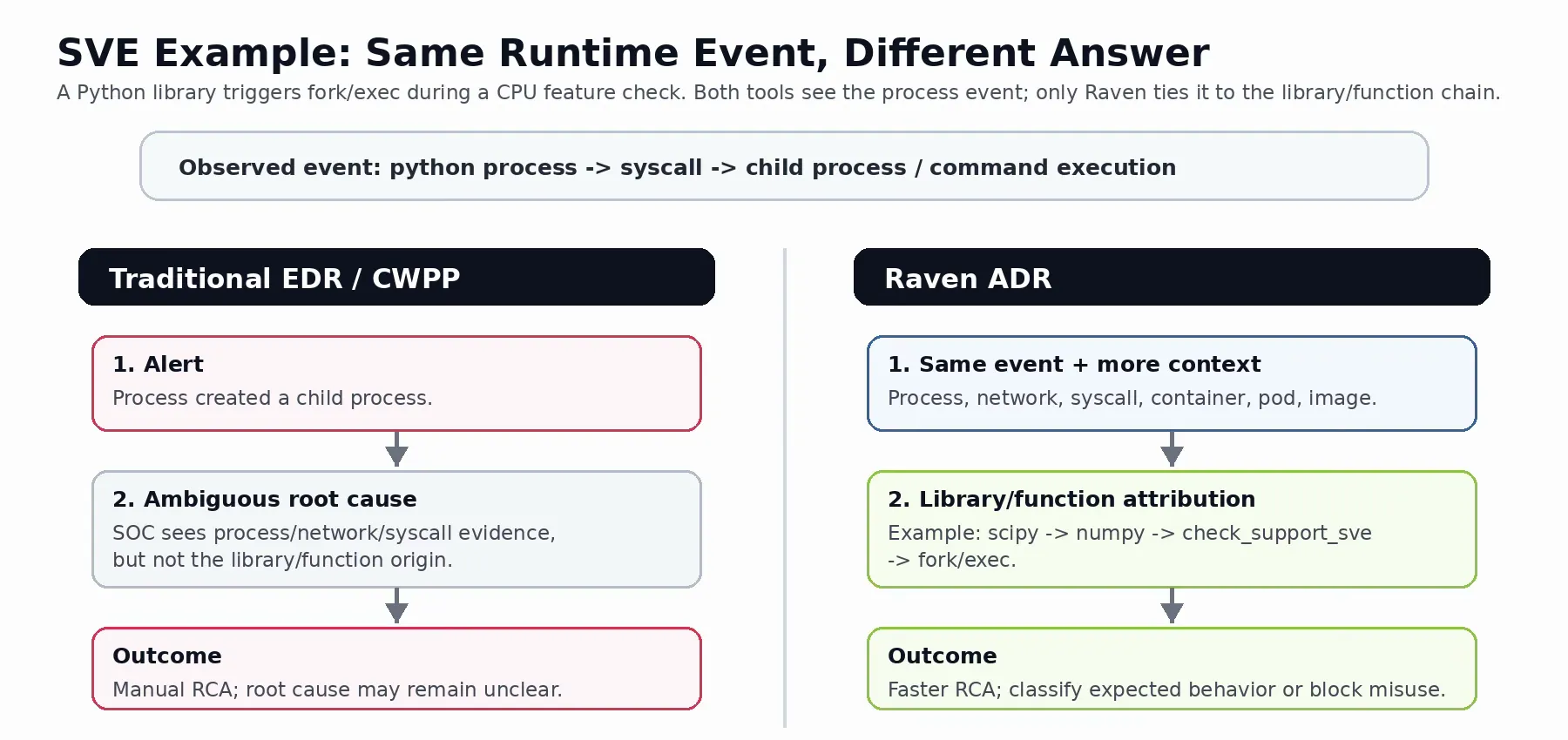
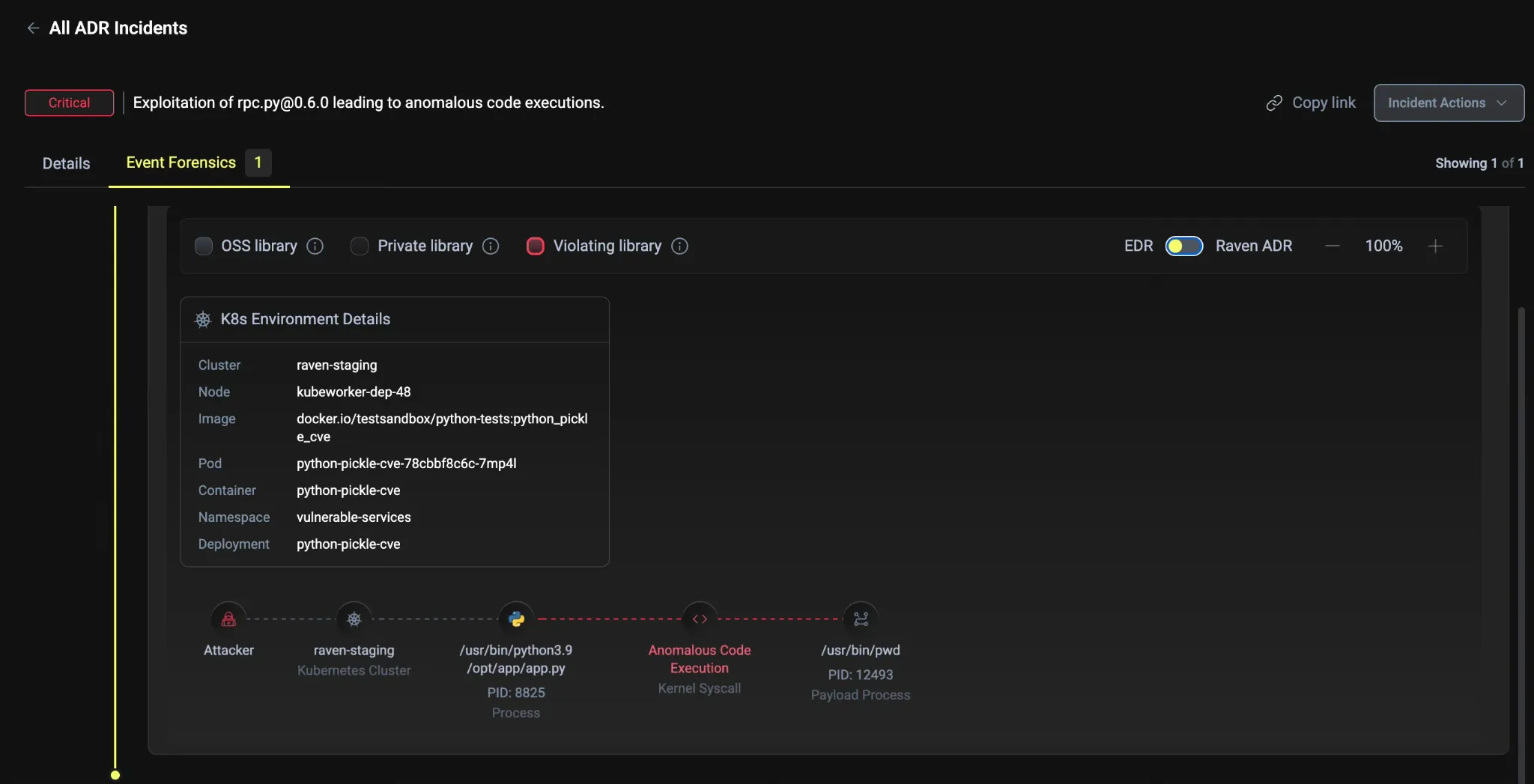
Visual Example: EDR View vs. ADR View
The following example illustrates the difference between a process/workload-centric EDR view and an application-runtime ADR view.
Runtime SCA: From Static Inventory to Runtime Truth
Traditional SCA and CNAPP vulnerability modules usually begin with static evidence: packages found in source code, manifests, container images, SBOMs, or workload inventory. That is useful, but it does not prove whether vulnerable code actually runs in production.
Runtime SCA adds runtime evidence to vulnerability prioritization. It can distinguish between vulnerable components that are merely present and vulnerable components that are loaded, executed, or reaching the vulnerable function.
Practical difference: traditional SCA tells the customer what vulnerable packages exist. Runtime SCA tells the customer which vulnerable libraries and vulnerable functions actually execute in production.
ADR + Runtime SCA Together
The advantage of ADR combined with Runtime SCA is the connection between runtime detection, runtime prevention, and runtime vulnerability prioritization.
- ADR detects and prevents abnormal application behavior at the library/function/call-chain level.
- Runtime SCA prioritizes vulnerabilities based on runtime evidence: disk, memory, CPU execution, and vulnerable-function execution.
- Library-level ADR prevention blocks the specific dangerous syscall or runtime action caused by a violating library/function chain.
- ADR gives developers remediation context: package, version, function, image, service, workload, and runtime behavior.
Runtime Gatekeeper and CI/CD Control
ADR can also extend runtime application prevention into the software delivery pipeline through Runtime Gatekeeper and CI/CD integration. This is important for software factories because prevention should not only happen after deployment; runtime knowledge should also influence what is allowed to move toward production. See runtime application prevention for more.
A CI/CD integration can automate the transmission of image build metadata from image build pipelines into the runtime security platform. The CI step typically runs after docker build and before docker push, while the image is still available inside the CI pipeline. This allows runtime intelligence to be associated with build context without collecting sensitive CI data such as passwords.
Prevention: Broad Blocking vs. Surgical Blocking
Traditional EDR/CWPP prevention often operates at broader levels, such as process, workload, network, file, malware, or host policies. ADR prevention is more surgical. ADR can block the specific syscall-level action originating from the violating library/function chain, without killing the entire process or stopping the application. For a comparison with RASP-style approaches, see RASP vs WAF vs ADR.
Buyer Fit: Infrastructure Security vs. Software Factory Security
Traditional EDR, CWPP, and CNAPP runtime sensors are strong infrastructure and cloud workload tools. They are useful for infrastructure security teams, cloud security teams, and SOC teams that need broad host, container, process, network, and cloud context.
ADR is designed for organizations where the CISO is responsible for defending a software factory: a large engineering organization that builds applications, ships containers, uses open-source dependencies, and operates high-velocity CI/CD pipelines.
ADR vs EDR: The General Runtime Security Gap
Traditional EDR/CWPP and cloud workload runtime sensors are strong at broad infrastructure and workload context. They commonly provide visibility into runtime activity such as processes, network connections, file activity, system calls, containers, hosts, and cloud assets. That view is useful, but it usually remains centered on the workload rather than the application layer detection layer inside the workload.
The EDR application layer gap is not simply about process or network visibility. EDR already sees many of those signals. The differentiation is application-runtime code visibility: library, function, syscall, call-chain attribution, Runtime SCA, vulnerable-function execution, surgical prevention, and CI/CD policy control. For more context on application detection and response and how it addresses this gap, see Raven’s overview.
Summary
Traditional EDR and CWPP runtime sensors provide important workload, process, network, and cloud context. These tools are valuable, especially for infrastructure and SOC workflows.
ADR fills a different and deeper gap: application detection and response security. ADR connects runtime behavior to the exact library and function path that caused it, prioritizes vulnerabilities based on runtime execution, and can surgically block only the dangerous syscall or action from the violating library/function chain.
EDR helps secure the workload. ADR secures the application runtime inside that workload. In the ADR vs EDR comparison, ADR shows which library caused the behavior, whether the vulnerable function actually executed, and what the developer should fix or what ADR should surgically block.