.svg)
.svg)


Days to Seconds: A New Approach to Application MTTR
MTTR is one of the most important metrics in cybersecurity because it measures how long risk remains unresolved after a threat, vulnerability, or suspicious behavior is discovered.
For years, that timeline followed a familiar pattern. An alert fired, an analyst investigated, logs were searched, tickets were opened, application owners were identified, and engineering was brought in to test and deploy a fix. Days, weeks, or even months later, the issue was finally contained or remediated.
That process is becoming increasingly difficult to sustain.
Modern applications are assembled from open-source libraries, frameworks, SDKs, APIs, and third-party packages. Vulnerabilities are often buried several layers deep inside transitive dependencies, leaving security teams with a long list of findings but little evidence about which ones are actually loaded, reachable, or executing in production.
At the same time, AI is increasing the speed and scale of both attacks and defensive operations. Attackers can accelerate vulnerability research, reconnaissance, payload creation, and exploit adaptation. Defenders are using AI SOC agents to summarize alerts, correlate signals, and guide investigations.
But AI can only reason over the context it receives.
A server-level alert may show that Python spawned a shell, a Java process opened an outbound connection, or a container behaved unusually. It may not explain which application library, function, request, or call chain caused that behavior.
That missing application context is one of the biggest barriers to reducing MTTR.
Runtime application security changes the equation by showing security teams what is actually happening inside the running application. It connects suspicious behavior and vulnerable components to the exact application, library, function, and execution path responsible.
This does not make every code fix happen instantly. Engineering may still need to upgrade a package, test compatibility, rebuild the application, and deploy the change. What runtime application security can do is reduce the time required to determine whether the risk is real, identify what executed, route the issue to the correct owner, and contain malicious behavior while the permanent fix is completed.
That is how application MTTR can move from days of investigation to seconds of runtime context and protection.
Key Takeaways
- MTTR in cybersecurity commonly means mean time to respond or mean time to remediate.
- Mean time to respond measures how quickly meaningful action begins after detection.
- Mean time to remediate measures how long it takes to fully resolve the underlying issue.
- MTTR is often evaluated alongside mean time to detect, or MTTD, and mean time to contain, or MTTC.
- High application MTTR is often caused by alert overload, unclear ownership, slow engineering handoffs, and a lack of runtime context.
- Runtime application security reduces time to understand, prioritize, and contain risk by showing what is loaded, reachable, executing, and exploitable in production.
- Runtime prevention can reduce exposure during the remediation window, even before a permanent patch is deployed.
What Is MTTR in Cybersecurity?
MTTR is a cybersecurity metric used to measure the average amount of time an organization takes to respond to or remediate a security issue.
The acronym can represent several related measurements, including mean time to respond, repair, recover, or resolve. In security operations and application security, the two most relevant definitions are mean time to respond and mean time to remediate.
These measurements are related, but they answer different questions. Mean time to respond measures how quickly the team begins meaningful action, while mean time to remediate measures how long it takes to remove or permanently resolve the risk.
The distinction matters because starting an investigation is not the same as protecting the application.
A security team may acknowledge an alert within minutes, create a ticket within an hour, and assign it to engineering that same day. The vulnerable code path may still remain available in production for weeks. Response starts the process, remediation completes it, and runtime protection can reduce the immediate risk in between.
Mean Time to Respond
Mean time to respond measures how long it takes a security team to begin meaningful action after detecting an issue.
That action may include triaging an alert, opening an investigation, validating a vulnerability, identifying the affected application, assigning an owner, beginning containment, or escalating the issue to engineering.
For a SOC, mean time to respond may measure the interval between an alert firing and an analyst starting an investigation. For an incident response team, it may measure how quickly containment begins. For an AppSec or vulnerability management team, it may measure how quickly a finding is reviewed, prioritized, and routed to the correct application owner.
This version of MTTR is useful because it measures operational responsiveness. However, it does not show whether production risk has actually been reduced. A team can respond quickly while the exploitable application remains exposed.
Mean Time to Remediate
Mean time to remediate measures how long it takes to fully resolve a security issue.
For an application vulnerability, remediation may require upgrading or replacing a dependency, changing code, testing the fix, rebuilding the application, deploying the new version, and confirming that the vulnerable path is no longer reachable in production.
For a security incident, remediation may include removing persistence, rotating credentials, restoring systems, patching the exploited weakness, and confirming that the attacker no longer has access.
Remediation MTTR is often harder to reduce because it spans multiple teams and workflows. Security identifies the problem, AppSec validates the risk, engineering develops the fix, platform teams deploy it, and application owners confirm that the service still works.
This makes remediation MTTR more than a SOC metric. It is a measure of how efficiently security, engineering, and operations convert a finding into measurable risk reduction.
Application MTTR Requires More Than One Clock
A single MTTR number can hide where the greatest delays actually occur.
For application security, it is often more useful to examine the full path from detection to resolution. That includes the time required to identify the issue, understand what happened inside the application, determine whether the risk is real, contain dangerous behavior, complete the permanent fix, and verify that the change reached production.
Traditional security tools frequently measure detection and response. Runtime application security strengthens the middle of the process by reducing the time required to understand, prioritize, and contain application-layer risk.
That middle section is where many investigations stall. Analysts may know that a process behaved suspiciously without knowing which library caused it. AppSec may know that a vulnerable package exists without knowing whether the affected function is reachable. Engineering may receive a ticket without enough context to reproduce or prioritize the issue.
Each of those gaps adds time to MTTR.
How MTTR Relates to MTTD and MTTC
MTTR is usually measured alongside other security operations metrics. Two of the most common are MTTD and MTTC.
Together, these metrics show how quickly an organization can detect, investigate, contain, and resolve security risk.
MTTD: Mean Time to Detect
Mean time to detect measures how long it takes to discover a threat, vulnerability, exploit attempt, or security issue after it appears.
Lower MTTD means the organization is finding problems faster, but fast detection alone does not reduce risk. An alert without sufficient context can remain in a queue while analysts search logs, identify the affected application, and determine whether the signal represents a real threat.
Fast detection without fast understanding simply creates a faster-growing backlog.
MTTC: Mean Time to Contain
Mean time to contain measures how long it takes to limit or stop the threat after detection.
Containment is not necessarily the same as permanent remediation. For an application-layer attack, it may involve blocking malicious command execution, preventing a dangerous process from spawning, stopping an exploit-driven outbound connection, isolating an affected service, or applying a runtime compensating control.
Containment matters because a permanent fix may not be immediately available. A vendor may not have released a patch, engineering may need to test an upgrade, or a production deployment may require approval and a maintenance window.
In those situations, containment reduces exposure while remediation continues.
How the Metrics Work Together
The ideal workflow moves from detection to understanding, prioritization, response, containment, remediation, and production verification.
In practice, the process is rarely that clean. Alerts may not contain enough application context, vulnerability findings may not show whether the affected code is reachable, ownership may be unclear, and engineering may need to reproduce the behavior before accepting the ticket.
Every unanswered question adds time to MTTR.
How to Calculate MTTR
The basic MTTR formula is:
MTTR = Total response or remediation time ÷ Number of resolved incidents or vulnerabilities
The calculation is simple. Defining the beginning and end of the measurement is more difficult.
For mean time to respond, the clock may start when an alert or vulnerability is detected and end when the team begins meaningful action.
For mean time to remediate, the clock may start when the issue is confirmed and end when the permanent fix has been deployed and verified.
Teams should document the exact definition they use and apply it consistently.
Example MTTR Calculation
Suppose a security team remediates five application vulnerabilities during one month. The remediation times are 4, 8, 24, 48, and 96 hours.
The total remediation time is 180 hours.
180 hours ÷ 5 vulnerabilities = 36 hours
The team’s mean time to remediate is 36 hours.
That average provides a useful benchmark, but it does not explain why some issues took longer than others. One vulnerability may have affected a small internal service, while another may have been buried in a transitive dependency inside an internet-facing application. A third may have required a vendor patch that was not yet available.
MTTR shows how long remediation took. Runtime context helps explain why.
Why MTTR Can Be Misleading
MTTR should be treated as a directional metric rather than a complete measure of security maturity.
A team might report a low MTTR because it closes simple findings quickly while difficult, high-risk vulnerabilities remain unresolved. Another team might have a higher average because it focuses its resources on complex production risks rather than easy tickets.
The number may also be distorted by inconsistent start and end points, reopened vulnerabilities, low-risk findings resolved in bulk, or long-running incidents that remain excluded from the calculation.
For that reason, security teams should segment MTTR by severity, application, environment, exposure, and issue type whenever possible. In application security, it is especially useful to compare internet-facing and internal applications, reachable and unreachable findings, direct and transitive dependencies, and contained and uncontained issues.
The goal is not to produce the smallest possible dashboard number. The goal is to reduce the amount of time meaningful application risk remains open.
Why Application MTTR Matters More in the AI Era
MTTR has always mattered, but AI is increasing the cost of slow investigation and remediation.
Attackers can now move faster through many familiar parts of the attack process, including researching public vulnerabilities, understanding application frameworks, generating proof-of-concept code, modifying payloads, automating reconnaissance, and adapting around defensive controls.
They do not need AI to discover an entirely new class of vulnerability. Moving through existing attack steps faster is enough to shrink the time defenders have to act.
Security teams face the opposite challenge. Defenders must identify every affected application, verify whether the vulnerable code is in use, determine the owner, create a fix, test it, deploy it, and validate the result.
Attackers need one working path. Defenders need enough context to close every relevant path without breaking production.
This structural difference makes runtime evidence increasingly important.
AI SOC Agents Are No Longer the Bottleneck
For the first time, AI SOC agents can reason across low-level code visibility and traditional security telemetry without requiring a human analyst to understand every programming language used across the application environment. This removes a major investigation bottleneck. Instead of waiting for a specialist who understands Java, Python, Node.js, or PHP to interpret what happened, an AI SOC agent can analyze runtime evidence alongside process, network, identity, and workload signals.
AI SOC agents are already effective at summarizing alerts, correlating telemetry, and recommending response actions. Their value increases significantly when they can also see what is happening inside the application.
An AI system may know that a server-side process spawned a shell, a container opened an unusual outbound connection, or a workload generated an anomalous system call. Those signals describe what happened around the application, but they may not explain what caused it.
To make an accurate application-layer decision, the AI SOC agent also needs to know which library initiated the behavior, which function executed, which call chain led to it, which request triggered it, and whether the vulnerable code was loaded or reachable in production.
Runtime application visibility provides that missing context. It allows AI SOC agents to connect traditional SOC telemetry to the exact application execution path behind the event, moving the investigation from a generic infrastructure alert to a code-level explanation and a more actionable response.
Why Traditional Application Remediation Takes So Long
Application remediation often takes longer than expected because the security team must establish whether the vulnerable package is actually deployed, loaded, and reachable before engineering can act with confidence.
The team may also need to determine whether the application is exposed to untrusted input, which version is running in production, which service owns it, and whether suspicious behavior is connected to the dependency.
Without runtime evidence, answering those questions requires manual investigation across scanners, source repositories, containers, logs, deployment systems, and ticketing platforms.
This is why more findings do not necessarily lead to faster remediation. They often create more work between detection and action.
What Causes High Application MTTR?
High application MTTR rarely comes from one broken process. It is usually caused by friction across detection, investigation, ownership, and engineering.
Alert and Vulnerability Overload
Security teams receive findings from SAST, SCA, DAST, WAFs, EDR, CWPP, CNAPP, cloud platforms, container scanners, SIEMs, and other tools.
Each product may identify a legitimate signal, but the combined volume makes prioritization difficult. When every finding appears urgent, analysts and developers spend time reviewing theoretical risk while meaningful production exposure remains unresolved.
Lack of Runtime Context
Infrastructure-focused tools can show processes, files, network connections, system calls, hosts, and containers. That telemetry is useful, but it may stop before identifying the application code responsible.
A process event such as “Python spawned a shell” still leaves the team to determine which application triggered it, which package initiated the behavior, which function executed, and whether the activity was legitimate or exploit-driven.
Each missing piece of context increases investigation time.
Unclear Application Ownership
Even a well-documented vulnerability cannot be fixed quickly when the responsible team is unknown.
Modern applications may span many services, repositories, containers, and deployment environments. Security teams frequently spend hours or days identifying the group that owns the affected code.
Runtime evidence can associate behavior with the running service and deployment, improving routing and reducing back-and-forth between teams.
Static Prioritization
Traditional vulnerability prioritization often begins with severity scores and package presence.
Those signals do not always show whether a vulnerable code path is active in the running application. A critical vulnerability in an unloaded library presents a different immediate risk than the same vulnerability executing inside an internet-facing service.
Treating both findings as equal creates unnecessary triage and slows the response to the vulnerability that matters more.
Patch Testing and Deployment Requirements
Even after a vulnerability has been validated, permanent remediation takes time.
Dependencies need compatibility testing, code changes require review, applications must be rebuilt, and production deployments may need approval or maintenance windows.
These processes protect application stability and cannot always be eliminated. Security teams therefore need a way to reduce exposure while the patch moves through development and deployment.
How Runtime Application Visibility Reduces MTTR
Runtime application visibility reduces MTTR by replacing investigation assumptions with evidence from the running application.
It helps security teams understand what code is active, how it behaves, and whether a vulnerability or attack path represents real production risk.
The greatest improvement often occurs across three stages: understanding the issue, containing the immediate risk, and giving engineering the evidence needed to complete remediation.
Reducing Time to Understand
Runtime application visibility can connect suspicious behavior to the application code responsible.
Instead of receiving only a server-level event, analysts can see the affected application, service, library, function, call chain, request, process, container, and workload.
This context reduces manual log searches and helps the security team understand the root cause sooner. It also gives AI SOC agents higher-quality evidence to reason over, improving the accuracy and usefulness of automated investigations.
Reducing Time to Prioritize
Runtime evidence helps teams distinguish between package presence and actual production exposure.
Rather than treating every vulnerable package as equally urgent, security teams can determine whether the component is loaded, whether the affected function is reachable, whether it has executed, and whether the application is exposed to untrusted input.
That distinction allows organizations to prioritize based on real runtime behavior instead of theoretical severity alone.
Engineering receives fewer, better-supported tickets, while security can focus on the code paths most likely to create meaningful risk.
Reducing Time to Contain
Permanent remediation may require days or weeks. Runtime prevention can reduce risk during that window by stopping dangerous execution inside the application.
Depending on the behavior, runtime containment may prevent exploit-driven command execution, unauthorized process spawning, dangerous file access, suspicious outbound connections, vulnerable function abuse, or malicious behavior without a known CVE.
This gives teams an alternative to deploying an untested patch immediately or leaving the application fully exposed.
Runtime protection can reduce the immediate risk while engineering completes the permanent fix.
Improving the Engineering Handoff
Generic vulnerability tickets frequently create more questions than answers.
A static finding may tell engineering that a package with a critical CVE exists somewhere in an application, but it may not show whether the package is loaded, where the vulnerable function is called, or whether the behavior occurred in production.
Runtime evidence gives engineering a more actionable starting point by showing that a specific package version is loaded in a production service, that the affected function is reachable through a known call chain, and that the path was triggered by a particular request or runtime event.
That level of detail reduces reproduction time, clarifies ownership, and helps engineering choose the correct remediation.
Verifying Remediation in Production
Deploying a fix does not always prove that the risk is gone.
The old version may still be running in another service, a container may not have been replaced, or the vulnerable function may remain reachable through a different dependency path.
Runtime visibility helps verify what is actually running after remediation. Teams can confirm that the affected component is no longer loaded, the vulnerable path is no longer reachable, and no unpatched deployments remain active.
That provides a more meaningful endpoint for remediation MTTR than simply closing a ticket.
Runtime Prevention Does Not Replace Remediation
Reducing MTTR does not mean avoiding permanent fixes.
Runtime prevention and application visibility complement secure development, vulnerability management, patching, EDR, cloud security, and existing incident response workflows.
The permanent fix still matters. The difference is that teams no longer have to leave the application unprotected while waiting for the fix to be completed.
A mature application MTTR strategy should measure both how quickly the organization can protect the application and how quickly it can permanently remove the underlying issue.
Runtime security can significantly reduce the first timeline while helping shorten the second.
Where Raven Fits
Raven helps security teams reduce application MTTR by providing visibility and protection inside production applications.
Raven traces application behavior to the exact library, function, and call chain responsible. It connects that execution to the affected service, process, container, image, node, and workload so security teams can understand what happened without manually stitching together disconnected signals.
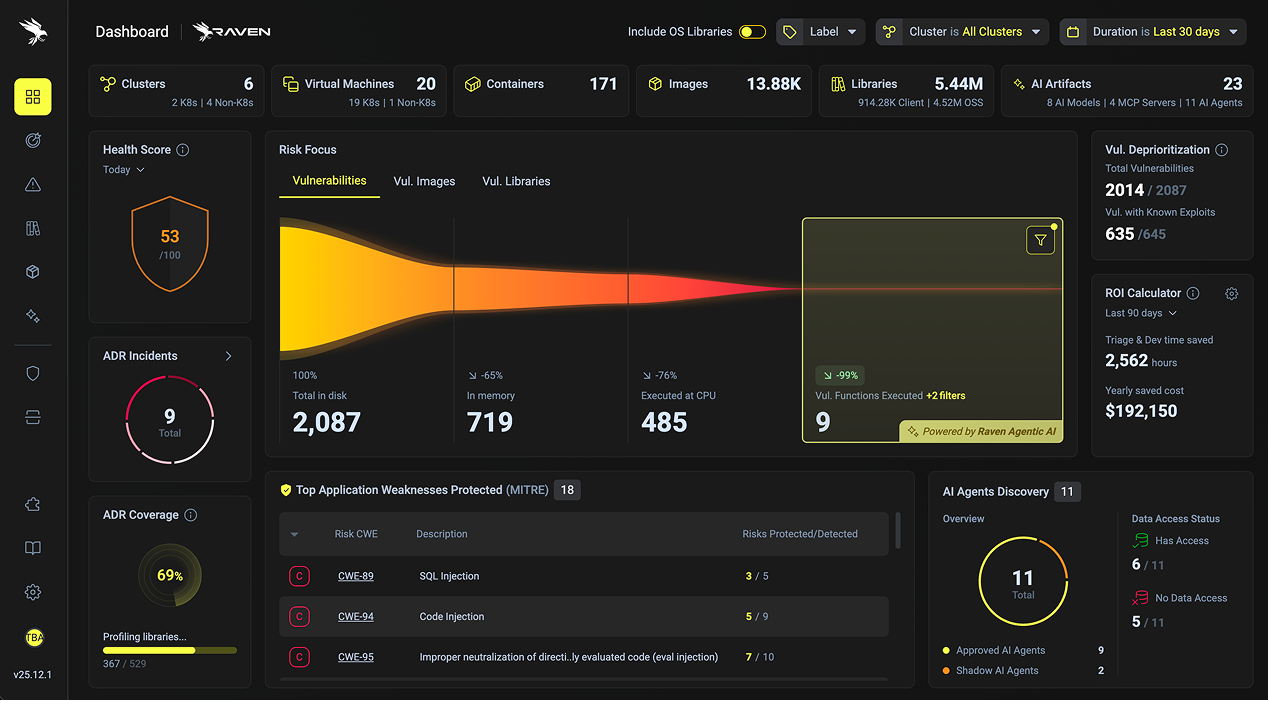
For vulnerability management, Raven Runtime SCA shows which components are present, loaded, reachable, and executing in production. This helps teams distinguish vulnerable packages that merely exist from vulnerable code that creates meaningful runtime exposure.
For detection and response, Raven Runtime ADR provides application-level context behind suspicious behavior. Instead of stopping at a process or system call, teams can see the code and execution path that caused it.
Raven Runtime Prevention helps stop malicious execution during the remediation window, whether the attack is tied to a known CVE, a zero-day, or CVE-less behavior.
Together, these capabilities help security teams determine whether the risk is real in production, understand what code caused the behavior, identify the affected service and owner, and decide whether to patch, block, or monitor.
This moves the workflow from: We found a vulnerability.
To: We know where it is running, whether it is reachable, what it did, who owns it, and how to protect the application now.
Measuring the Impact of Runtime Visibility on MTTR
Organizations adopting runtime application security should measure more than one broad MTTR number.
Useful application security metrics include the time from detection to application identification, alert to root-cause function, vulnerability discovery to runtime validation, confirmation to containment, confirmation to owner assignment, and patch deployment to runtime verification.
Teams can also track the percentage of critical findings proven reachable, the number of findings deprioritized through runtime evidence, and the percentage of exploited paths contained before permanent remediation.
These measurements reveal where runtime visibility is removing friction and where process improvements are still required.
MTTR Should Measure How Quickly Risk Goes Down
MTTR is not just a dashboard number.
It measures how efficiently a security program turns detection into understanding, understanding into protection, and protection into permanent risk reduction.
That process is becoming more important as applications grow more dependent on open-source components and attackers use AI to move faster.
AI SOC agents can accelerate investigations, but only when they have enough context to understand what happened. Server, process, and workload signals provide part of the story. Security teams also need to know which application library, function, request, and execution path caused the behavior.
Runtime application security supplies that missing layer. It helps teams identify what is real, determine what is reachable, contain dangerous behavior, route the issue to the correct owner, and verify the permanent fix in production.
The patch itself may still take time. Understanding and protecting the application should not.
See how Raven uses runtime visibility and prevention to help security teams reduce application risk from days to seconds.