Gartner listed Raven as a Representative Provider in Innovation Insight: Application Detection and Response (ADR) (13 November 2026, ID G00850974).
In Raven’s view, the inclusion is an important company milestone. It is also a sign that a long-standing gap in application security is receiving overdue attention. Security teams need visibility and control inside running applications, at the point where vulnerabilities become exploits and application behavior becomes an incident.
Gartner describes the need directly:
"Vulnerabilities in production applications are inevitable. Detecting and responding to attacks requires more than visibility into application traffic; it demands visibility into application execution."
Source: Gartner, Innovation Insight: Application Detection and Response (ADR), 13 November 2026, ID G00850974.
This is the premise Raven was built around. An attack becomes real when code executes. Defenders need to know which application, library, function, and call chain produced the behavior, then investigate or stop the dangerous action while it is happening.
Why ADR Matters Now
Security teams have made major investments in secure development, scanning, perimeter controls, and cloud workload protection. Those layers remain essential, but they do not always explain what happens after traffic reaches a running application.
A WAF may see an allowed request. An endpoint or container tool may later see a Java or Python process launch a command. The critical evidence sits between those events: which package handled the request, which function executed, which call chain reached the sensitive operation, and whether the behavior was expected or malicious.
That gap is becoming more consequential as attackers move faster. The 2026 Verizon Data Breach Investigations Report identifies exploitation of vulnerabilities as the leading initial access vector in the breaches analyzed.
Recent disclosures including PHP2Shell, Node2Shell, and Java4Shell show how vulnerabilities deep in shared runtimes and libraries can expose many applications at once.
Defenders need to know whether affected code is present, reachable, and executing, and what it is doing in production. They cannot wait for signatures, public CVEs, or remediation processes that move at human speed.
Application Detection and Response adds that missing layer. ADR observes running application behavior, connects suspicious activity to the code path responsible, and supports investigation, response, and prevention.
Why Raven Is Built for the ADR Category
Raven was designed to explain and control application attacks at the layer where code executes.
Application-Level Evidence
Raven observes execution down to libraries, functions, dependencies, and call paths, then connects that evidence to the process, container, image, pod, node, and service around it.
Instead of stopping at "a process launched a command," Raven can show which application path produced the action. That context helps security teams validate alerts, identify the affected service, route the incident to the right owner, and investigate with less guesswork.
One Runtime Platform for Prioritization Detection and Prevention
Raven brings together three capabilities that are often separated:
• Runtime SCA shows which components are present, loaded, reachable, and executing, including vulnerable-function evidence.
• Raven ADR detects and investigates application-layer exploitation with library, function, and call-chain context.
• Runtime Prevention applies prevention policies down to the library level, stopping exploits in real time whether they target a known CVE or an unknown vulnerability.
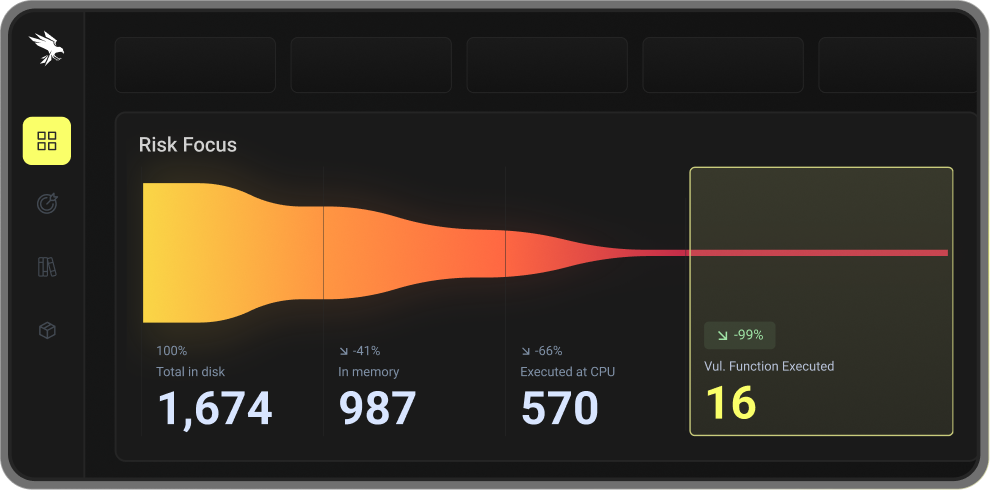
The same runtime evidence can help AppSec prioritize real production exposure, help the SOC investigate active exploitation, and help platform teams apply protection while a permanent fix moves toward production.
Production Deployment Without Application Code Injection
Raven uses eBPF-based infrastructure instrumentation and does not require application source-code changes or code injection. This is designed to give security teams application-level evidence without asking every development team to add and maintain another component inside each service.
Raven Runtime Prevention can also evaluate dangerous behavior in the context of the library and call chain involved. That allows teams to address supported attack actions without waiting for an exploit-specific signature or public CVE.
ADR Is Becoming a Production Requirement
Modern applications are built largely from code teams do not own. J.P. Morgan's 2026 Patchmageddon report notes that 77% of commercial code is made up of prebuilt open-source libraries and frameworks. Preproduction scanning can identify known risk, but it cannot show which dependencies load, which functions execute, or how that code behaves under real production conditions.
NYDFS Section 2.5 points in the same direction, recommending enhanced monitoring and validation of expected third-party code and application behavior. For financial institutions, the question is not only whether a dependency is approved, but whether it behaves as intended in production.
That is why ADR is becoming critical. Raven connects library, function, and call-chain evidence to prioritization, detection, investigation, and prevention. As AI accelerates vulnerability discovery and exploitation, security teams need protection that operates at execution speed.