.svg)
.svg)


Application security vulnerabilities are weaknesses in an application’s code, design, configuration, dependencies, or runtime behavior that attackers can exploit to gain unauthorized access, steal data, disrupt services, or execute malicious code.
Most application security programs are built to find these weaknesses before production. SAST analyzes source code, DAST tests applications from the outside, and SCA identifies vulnerable open-source packages. These controls remain essential, but finding a vulnerability does not show whether attackers can reach it in a live application or stop them when exploitation begins.
That gap matters because modern applications are assembled from custom code, open-source libraries, frameworks, APIs, and third-party services. A vulnerability may sit inside a transitive dependency, become reachable only through a specific function, or emerge when several legitimate components interact at runtime.
The exploit itself may also have no known CVE or signature. Attackers can abuse application logic, manipulate a trusted function, exploit a malicious dependency, or create a new execution path that static and perimeter controls were not designed to recognize.
Raven focuses on this missing layer inside the running application. Runtime application visibility shows which components are loaded, which vulnerable functions are reachable, and what the application attempts to do when exploitation occurs. Runtime prevention can then stop dangerous behavior before a vulnerability becomes a compromise.
Key Takeaways
- Application security vulnerabilities are weaknesses in code, design, configuration, dependencies, or runtime behavior.
- The OWASP Top 10:2025 groups major risks such as broken access control, security misconfiguration, software supply chain failures, injection, and insecure design.
- Known CVEs represent only part of application risk. Zero-days, logic abuse, compromised dependencies, and CVE-less paths may have no established identifier.
- SAST, DAST, and SCA help discover vulnerabilities, but they do not generally stop exploitation after code begins running in production.
- Runtime application visibility shows which libraries and functions are loaded, reachable, and executing.
- Runtime prevention stops malicious behavior at execution, whether the attack is tied to a known CVE or not.
What Are Application Security Vulnerabilities?
Application security vulnerabilities are flaws or weaknesses that allow software to behave in an unsafe or unauthorized way.
They may be introduced during design, coding, configuration, integration, deployment, or maintenance. Some originate in code written by the organization. Others come from open-source packages, frameworks, third-party services, build tools, or the surrounding application environment.
A vulnerability becomes especially important when attackers can reach it through an exposed route, API, upload function, message queue, user workflow, or another source of untrusted input.
Potential outcomes include unauthorized data access, remote code execution, privilege escalation, credential theft, record modification, service disruption, lateral movement, and persistent access.
Not every vulnerability creates the same level of production risk. A vulnerable package that exists in an image but never loads differs from the same package running inside an internet-facing application. A vulnerable function that cannot be reached differs from one processing untrusted requests in production.
This is why vulnerability management requires more than pre-production discovery. Security teams also need runtime evidence showing what is active, reachable, and exploitable in the live application.
The OWASP Top 10:2025 Application Security Categories
The OWASP Top 10 is a widely used reference for understanding major web application security risks. The 2025 edition includes ten broad categories rather than individual attack techniques.
1. Broken Access Control
Broken access control occurs when an application fails to enforce what a user is allowed to view or do.
An attacker may change an object identifier to access another customer’s records, call an administrative API directly, modify another user’s resources, or escalate from a standard account to a privileged role.
Client-side restrictions are not sufficient. Hiding a button or route does not prevent an attacker from calling the underlying endpoint.
Prevention requires server-side authorization checks on every sensitive request, deny-by-default policies, ownership validation, least privilege, and consistent enforcement across APIs and user interfaces.
2. Security Misconfiguration
Security misconfiguration includes insecure defaults, exposed administrative interfaces, unnecessary services, verbose error messages, weak permissions, missing security headers, and debugging features left enabled in production.
These weaknesses may appear in the application, framework, cloud service, container, server, or deployment pipeline. A small configuration error can expose data or functionality that was never intended to be public.
Secure defaults, infrastructure-as-code scanning, deployment validation, least privilege, and continuous production checks help reduce this risk.
3. Software Supply Chain Failures
Software supply chain failures affect the dependencies, tools, repositories, and processes used to build and deliver software.
Examples include outdated packages, malicious libraries, compromised maintainers, insecure registries, poisoned updates, vulnerable build tools, and CI/CD pipeline compromise.
The risk may enter through a direct dependency, a deeply nested transitive package, a developer tool, or a trusted software update. Because the component may arrive through an approved delivery path, it can appear legitimate until its behavior becomes visible at runtime.
4. Cryptographic Failures
Cryptographic failures occur when applications inadequately protect sensitive information.
Examples include unencrypted data, outdated algorithms, weak key management, predictable random values, improper certificate validation, and sensitive information exposed during transmission.
The issue is not always the complete absence of encryption. Applications may also use cryptography incorrectly or protect data in one part of the system while exposing it elsewhere.
5. Injection
Injection vulnerabilities occur when untrusted input is interpreted as part of a command, query, or executable instruction.
Common forms include SQL injection, operating system command injection, NoSQL injection, LDAP injection, and template injection.
The application fails to keep attacker-controlled data separate from executable logic. A crafted input may then modify a database query, launch a command, access unauthorized information, or trigger remote code execution.
Parameterized queries, safe APIs, strict input handling, contextual encoding, and least privilege reduce injection risk. Runtime prevention adds another layer by stopping dangerous behavior when the input reaches a sensitive function.
6. Insecure Design
Insecure design describes weaknesses in the intended architecture or workflow of an application rather than a single coding mistake.
Examples include unlimited password reset attempts, transactions without sufficient validation, sensitive actions without reauthentication, and workflows that assume users will follow an expected sequence.
A feature can be implemented exactly as designed and still be insecure if the design does not account for abuse.
Threat modeling, secure design patterns, abuse-case analysis, and security requirements early in development help reduce this risk.
7. Authentication Failures
Authentication failures allow attackers to impersonate users, compromise sessions, or bypass identity controls.
They may involve weak passwords, credential stuffing, insecure password recovery, predictable session identifiers, missing multifactor authentication, improper token validation, or sessions that remain active after logout.
Strong authentication requires secure token handling, rate limiting, multifactor authentication, identity validation, and careful management of the full session lifecycle.
8. Software or Data Integrity Failures
Software or data integrity failures occur when applications trust code, updates, plugins, or data without verifying authenticity and integrity.
Examples include unsigned software updates, insecure deserialization, untrusted extensions, compromised CI/CD workflows, and serialized data accepted without validation.
Signed artifacts, trusted repositories, build provenance, integrity checks, and restricted deployment permissions help reduce the risk.
9. Security Logging and Alerting Failures
Logging and alerting failures limit an organization’s ability to detect and investigate attacks.
Applications may fail to record access-control violations, authentication failures, administrative actions, or input validation errors. Logs may also lack the context needed to identify the user, route, service, library, or function involved.
Runtime application visibility can enrich security alerts with the code-level execution path behind suspicious behavior, helping the SOC move from a generic event to the application cause.
10. Mishandling of Exceptional Conditions
Mishandling of exceptional conditions includes improper error handling, unchecked return values, failing open, resource exhaustion, and application states that become unsafe when the normal path breaks.
An application may reveal sensitive information through an error, continue processing after a failed authorization check, leak resources after repeated exceptions, or leave a transaction in an inconsistent state.
Attackers intentionally create unusual conditions to test whether the application remains secure when expected behavior fails.
Beyond the OWASP Top 10: Zero-Days and CVE-Less Exploits
The OWASP Top 10 provides a useful framework, but it cannot cover every vulnerability or exploit path.
Security programs often organize risk around known CVEs because they provide standardized identifiers, severity scores, affected versions, and remediation guidance. That model works well after a vulnerability has been discovered, analyzed, and published.
Attackers do not always wait for that process.
A zero-day may be exploited before defenders have a patch, signature, or complete understanding of the weakness. A CVE-less attack may abuse application logic, a legitimate function, a malicious package, a configuration error, or a chain of behaviors that never receives a formal vulnerability identifier.
A zero-day generally refers to a vulnerability without an effective fix or established defensive knowledge. A CVE-less attack is broader and includes any attack path that does not rely on a published CVE.
These threats expose the limitations of controls that depend entirely on known vulnerability data and signatures. When no identifier exists, what the application attempts to do at runtime becomes one of the most valuable signals available.
Why Traditional Tools Miss Production Risk
Application security tools provide important coverage across different stages of development and operation. The limitation is that each sees only one part of the problem.
SAST Finds Potential Weaknesses in Code
Static application security testing analyzes source code, bytecode, or binaries without running the application.
It can identify unsafe coding patterns, data flows, injection risks, and other weaknesses early in development. However, it cannot always account for the exact production configuration, input, deployment, or execution path.
A static finding can show that dangerous code exists. It does not necessarily prove that attackers can reach it in the deployed application.
DAST Tests from the Outside
Dynamic application security testing interacts with a running application by sending requests and observing responses.
DAST can identify exposed weaknesses without requiring source-code access, but it may not know which internal function processed the request or which dependency caused the behavior.
Its coverage is also limited to the routes, inputs, and conditions exercised during testing.
SCA Finds Packages, Not Always Active Exposure
Software composition analysis identifies open-source dependencies and maps package versions to known vulnerabilities.
This provides essential inventory, but package presence does not always establish runtime risk. A dependency may exist in an image without loading, while another may actively process internet-facing requests through a vulnerable function.
Traditional SCA shows that a package is associated with a CVE. Runtime SCA shows whether the package is loaded, whether the affected function is reachable, and whether it executes in production.
WAFs Inspect Requests Before Execution
A web application firewall evaluates HTTP and HTTPS traffic and can block known attack patterns, suspicious payloads, and requests that violate policy.
Once the application accepts the request, the WAF generally cannot see which library handles it, which function executes, or what the application does several steps later.
Encoded, application-specific, and legitimate-looking payloads may also avoid matching a known rule.
EDR Sees Workload Behavior, Not Always the Application Cause
EDR and workload security tools monitor processes, files, network connections, system calls, and operating system behavior.
They may detect that Python spawned a shell or that a Java process opened an unusual connection. They may not identify which application library, function, request, or call chain caused the event.
The SOC sees the result but still needs to reconstruct the application-level root cause.
The Production Visibility Gap
Together, these tools may show that vulnerable code exists, a suspicious request arrived, and an unusual system event followed.
The missing link is the execution path inside the application.
Without that context, teams may struggle to determine whether the vulnerability is reachable, which service owns it, whether exploitation occurred, and what action should happen first.
Runtime application security closes this gap by observing the application where a vulnerability becomes operationally meaningful: during execution.
Stopping Application Exploits at Execution
Finding vulnerabilities remains essential. Preventing exploitation requires another layer.
Runtime application prevention evaluates what code attempts to do while the application runs. It connects libraries, functions, requests, and call chains to sensitive actions such as command execution, process creation, file access, and network connections.
This changes the security question from: Does vulnerable code exist?
To: Is the vulnerable code reachable, and what happens when someone attempts to exploit it?
Function-Level Runtime Context
Runtime application visibility identifies the library, function, and call chain responsible for an action.
For example, a workload tool may report that a Python process launched a shell. Runtime context can reveal which package and function initiated the process, which request reached it, and which service was affected.
That evidence helps the SOC determine whether the behavior was expected or exploit-driven. It also gives engineering a more direct path to remediation.
Stopping Known CVE Exploitation
Patching remains the preferred permanent fix for known vulnerabilities. Testing, approval, and deployment, however, can leave an application exposed for days or weeks.
Runtime prevention can protect the application during that window by stopping the exploit when it reaches the affected execution path.
This reduces the need to choose between an immediate, potentially disruptive deployment and leaving the application unprotected.
Stopping Zero-Day and CVE-Less Behavior
Runtime prevention does not have to rely entirely on a known vulnerability identifier.
Even a new exploit must eventually cause the application to perform an action. It may launch a command, access a sensitive file, open an unexpected connection, or reach a function through an abnormal execution path.
Behavior-based prevention evaluates that execution and can stop the action before it becomes a compromise.
Where Raven Fits
Raven provides runtime application security for production applications.
Raven Runtime ADR traces suspicious behavior to the exact library, function, request, and call chain responsible. It connects that code-level evidence to the process, container, image, node, service, and workload involved.
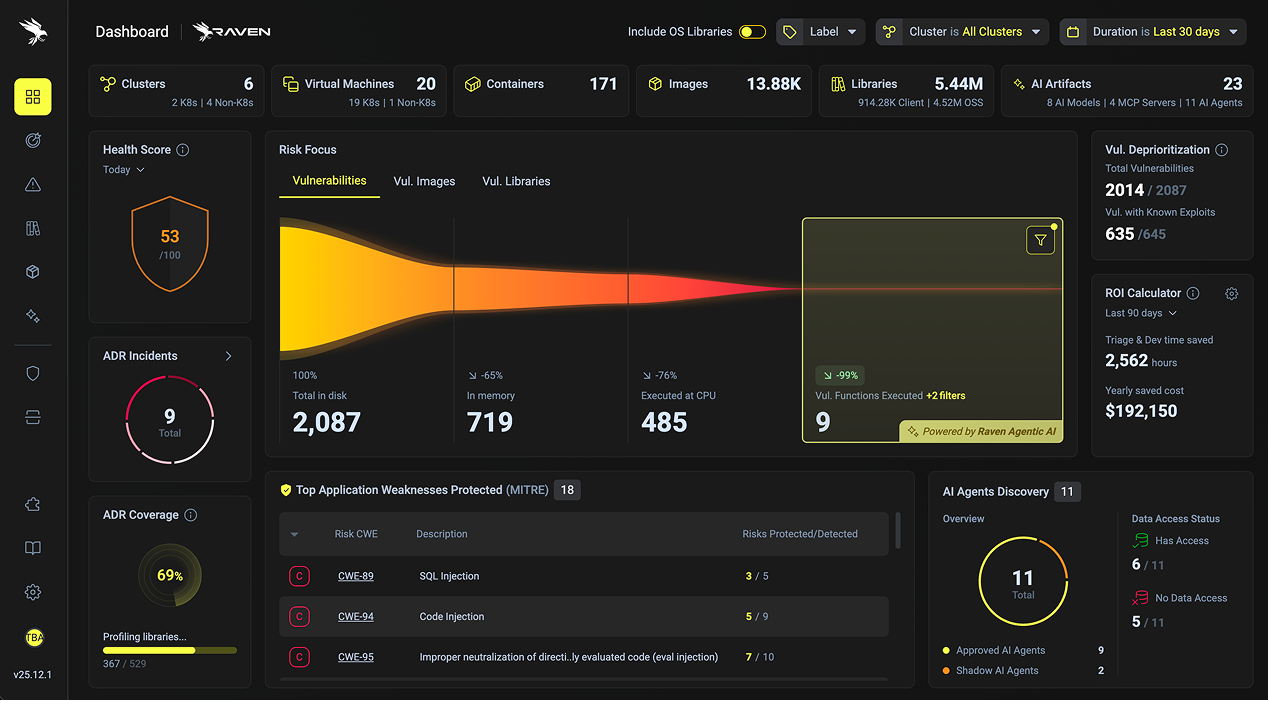
Raven Runtime SCA shows which open-source components are present, loaded, reachable, and executing in production. This helps teams distinguish package inventory from active exposure and prioritize vulnerabilities based on what matters in the live application.
Raven Runtime Prevention stops exploits and malicious behavior at execution, whether the attack is tied to a known CVE, a zero-day, or a CVE-less path.
These capabilities complement SAST, DAST, SCA, WAF, EDR, and cloud security controls. Existing tools help discover weaknesses and observe the surrounding environment. Raven adds the execution context and prevention layer inside the application.
Application Security Must Extend Into Production
Application security vulnerabilities can originate in custom code, open-source packages, application design, configuration, authentication, access controls, build systems, and deployment workflows.
The OWASP Top 10 provides an important framework, but the real production attack surface also includes zero-days, CVE-less exploits, malicious dependencies, and application-specific execution paths that static testing and known signatures may not identify.
Pre-production testing remains necessary, but it cannot observe every production configuration, input, dependency interaction, or exploit variation.
Runtime application security adds the missing layer by showing what code loads, which functions are reachable, and what the application attempts to do when an attack occurs. Runtime prevention can then stop dangerous execution before the vulnerability turns into damage.
See how Raven stops application vulnerabilities at execution.